Recientemente, la Procuraduría Federal del Consumidor (PROFECO), institución encargada de salvaguardar los derechos de los consumidores mexicanos, publicó en su revista del consumidor un análisis hecho a 36 marcas de mezcales comerciales para determinar si cumplen con las Normas Oficiales Mexicanas (NOMs).
Para que un destilado de agave pueda ser nombrado como mezcal, debe de cumplir con reglas específicas. La primera es que debe de ser producido dentro de uno de los 9 estados que cuentan con denominación de origen. La segunda, es que sean hechos 100% de agave.
En lo que concierne a las NOMs, los mezcales deben cumplir con lo que se establece en la etiqueta. Cuestiones que presenten claramente las características del mezcal en cuestión a los consumidores. Estas son la marca, el contenido alcohólico, la clase de mezcal, tipo de maguey empleado, lugar de procedencia, lote y datos del productor, entre otros.
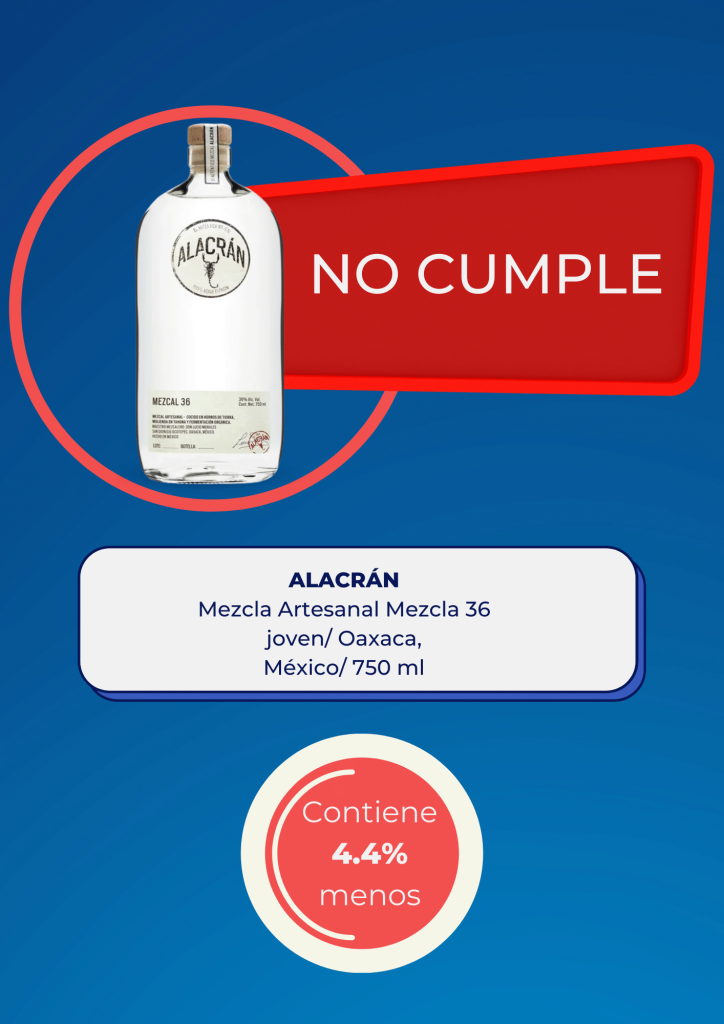
En este análisis, la PROFECO encontró irregularidades principalmente en el contenido alcohólico y componentes volátiles de las bebidas. A continuación te presentamos las marcas que no cumplieron con las NOMs y por qué no cumplen con ellas.
No cumple con los alcoholes superiores mínimos (100 mg/ 100ml de alcohol anhidro). Se encontró que varía de 83.7 a 128.6mg/100 ml del alcohol anhidro. Lo que quiere decir que su producción no es uniforme. Esto significa que la fermentación o destilación no está bien hecha. Adicionalmente, puede suponer que ellos agregan alcohol de fuentes no relativas a la fermentación del agave..
Menor contenido alcohólico al declarado en la etiqueta de su botella de mezcal
Mezcal 1903
Declara en su etiqueta que tiene 38% de alcohol. Sin embargo, el estudio encontró que en realidad tiene 37.2% de alcohol.
Mezcal Apaluz
Declara en su etiqueta que tiene 40% de alcohol. El estudio encontró que en realidad tiene 38.6% de alcohol.
Mezcal Kilómetro 70
Declara en su etiqueta que tiene 40% de alcohol. En el estudio se encontró que a diferencia de su etiqueta, tiene 39% de alcohol.
La publicación de la PROFECO nos recuerda la importancia de verificar las etiquetas de mezcal por nuestra seguridad y para comprobar su autenticidad. En exoap, adicional a esto, te lo recomendamos para que conozcas mejor las características propias de cada tipo de destilación, porcentaje de alcohol, tipo de agave y regiónes. Así te adentrarás más en el enorme mundo del mezcal!
Antes de acabar, queremos dejar claro que en exoap hacemos este tipo de publicaciones con el fin de informar a nuestros lectores. En ningún momento buscamos dañar la imagen de ninguna marca incluida en esta publicación. Al contrario, consideramos que dichos resultados podrían haber sido producto de las propiedades artesanales de los mezcales.
Esta web utiliza cookies propias y de terceros para su correcto funcionamiento y para fines analíticos. Contiene enlaces a sitios web de terceros con políticas de privacidad ajenas que podrás aceptar o no cuando accedas a ellos. Al hacer clic en el botón Aceptar, acepta el uso de estas tecnologías y el procesamiento de tus datos para estos propósitos.
Más información






1 Comment
[…] Conoce sobre aquí los mezcales que no cumplen con las Normas Oficiales Mexicanas según la Profeco. […]