Semiconductores en México: Oportunidades de Inversión Extranjera y Desafíos del Sector
March 25, 2026
Ciberdiplomacia la Regulación del Ciberespacio
March 29, 2026The practical guide to export and import from Mexico with legal and tax confidence.
No spam. Unsubscribe anytime.
Amid the global reconfiguration of supply chains, semiconductors have become one of the most sought-after strategic products in the world.
In this context, Mexico faces a critical decision: to move up within the global chip industry or remain an actor primarily focused on assembly.
As part of our ongoing coverage of this industry, Exoap participated in a presentation held at the Ministry of Economy on the current semiconductor landscape in Mexico and what is expected for the sector in the coming years.
To understand their impact and relevance in the global economy, it is first necessary to understand what semiconductors are.
¿What is Mexico’s current role in the semiconductor industry?
Considering that Mexico is currently part of the semiconductor industry, it is important to highlight that its participation remains limited, as it is not involved across all stages of the value chain. Download our International Trade Checklist for a complete overview of documentation, tariffs and customs requirements.
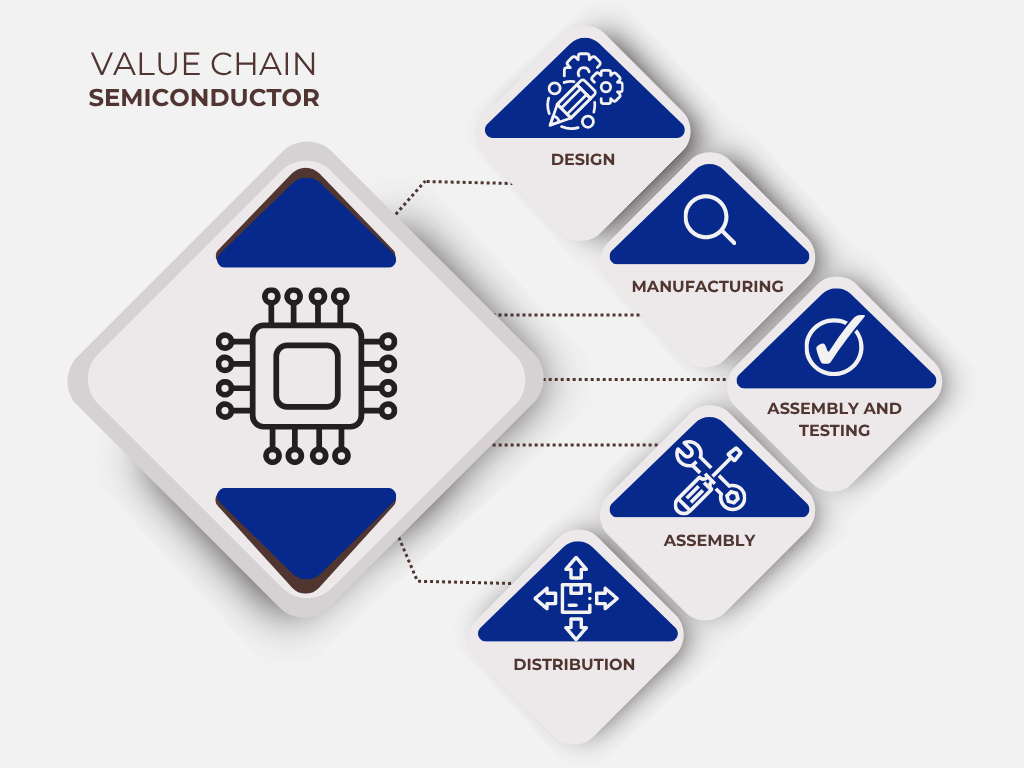
To better understand this, it is worth noting that the semiconductor value chain consists of several stages, including design, fabrication, assembly, testing, and packaging.
In this context, Mexico has a strong presence in key stages such as design, assembly, testing, and packaging. However, the fabrication of advanced chips continues to be a significant weakness.
¡Learn how international manufacturers are leveraging Mexico’s competitive advantages!
Even so, Mexico has important advantages, such as its experience in sectors like the automotive industry, which has enabled the effective transfer of skills into this emerging field.
Additionally, within the context of nearshoring—where companies seek to relocate production closer to key markets like the United States—Mexico positions itself as a strategic partner due to its geographic proximity and strong trade integration.
¡Learn more about nearshoring opportunities in Mexico here!
Taking this into account, between 2015 and 2018, Mexico’s semiconductor industry experienced notable growth in production within the sector.
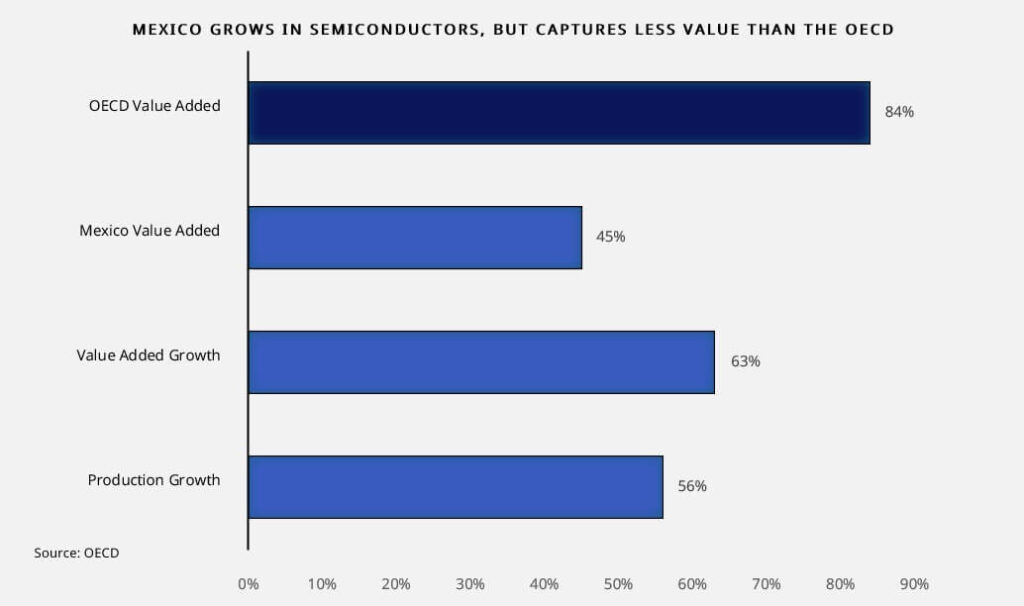
According to a report presented by the OECD at Mexico’s Ministry of Economy, the country achieved approximately 56% growth in the electronics sector, outperforming manufacturing, which recorded only about 13% growth during the same period.
This demonstrates that the sector is not only growing but also consolidating itself as one of the most dynamic technological industries in the country.
¡Learn more about how foreign investment is distributed in Mexico here!
Additionally, the sector’s value added increased by around 63% between 2019 and 2023, further confirming its dynamism compared to other technology industries. However, this growth does not necessarily translate into a greater economic contribution for the country.
Despite this progress, comparative evidence shows that Mexico still lags behind developed economies in terms of value capture within the sector.
As observed, while OECD countries reach levels close to 84% in value added, Mexico remains around 45%, highlighting a significant structural gap. This confirms that although the country has made progress in production and sector dynamism, it still faces limitations in capturing a larger share of the economic value generated.
Currently, it is estimated that only between 40% and 50% of electronic exports are actually manufactured in Mexico. This is largely due to the limited domestic production and implementation of inputs, as well as the country’s high dependence on imported components.
¿What is the OECD, its importance, and how does it work? Learn more here.
This highlights that, although Mexico actively participates in the production process, it does not capture the majority of the economic value generated, largely due to structural limitations that have prevented it from scaling into more advanced and higher-value stages within the industry.
¡Learn more about how foreign investment has transformed Mexican companies here!
¿What is holding back the growth of the semiconductor industry in Mexico?
Despite the opportunities available to Mexico, several factors are limiting its growth within the semiconductor industry.
Factors such as low investment in technology and research have significantly reduced the country’s capacity for innovation, as well as its ability to move into more complex stages of the value chain.
At the same time, there are operational barriers that affect the proper development of the sector, such as limited access to specialized machinery, customs processes that slow productivity, and challenges in handling sensitive technological inputs.
Additionally, Mexico faces critical structural challenges, including a lack of adequate infrastructure, limited access to reliable energy, water availability issues, and weaknesses in logistics connectivity.
These factors not only impact current operations but also limit the country’s ability to attract investment in high-complexity technology industries such as semiconductors.
In terms of human capital, Mexico presents both advantages and challenges. According to the National Institute of Statistics and Geography (INEGI), the technology sector employs around 250,000 people, highlighting the existence of a relevant workforce base for industry development.
However, significant challenges remain, including educational dropout rates, labor informality, and a lack of alignment between academic training and market needs.
This implies that, from a business perspective, Mexico has strong potential but still needs to strengthen these conditions to position itself as a competitive destination within the technology industry.
From the perspective of global technology companies such as Google, Apple, or Spotify, Mexico represents not only a market but also a potential regional operations platform.
¡Learn more about Google’s investment in Puebla here!
These companies evaluate factors such as the availability of technical talent, digital infrastructure, regulatory stability, and access to reliable energy.
In this sense, although Mexico offers competitive advantages in talent and geographic proximity, it still faces structural challenges that may limit long-term investment decisions.
¡Learn more about the sectors with the greatest investment potential in Mexico here!
Mexico facing a unique opportunity in semiconductors
All of the above places Mexico in a unique position within the global context, where it can leverage the reconfiguration of supply chains to scale within the industry.
For example, according to OECD data, around 17% of university graduates in Mexico are in fields such as engineering, providing a strong and relevant foundation for the development of this industry—surpassing the average share of students in this field in several developed countries.
¿Interested in investing in Mexico? Learn what soft landing is.
However, the country still faces key challenges such as limited investment, dependence on imported inputs, and infrastructure constraints that slow its growth.
In this context, Mexico stands in an intermediate position, with high potential but also existing challenges that require proper attention in order to strengthen its position in the global semiconductor market.
The real challenge for Mexico is not only to grow within the industry, but to transform within it. Moving from assembly to innovation will be key to capturing greater economic value. The country’s future in this sector will depend on its ability to make that leap.
Mexico is not competing solely on costs, but on its ability to position itself as a strategic player within the global semiconductor value chain.
The opportunity lies in the global reordering of the industry, which opens space for new players. The challenge is not just participation, but scaling toward higher-value stages.
For investors, the question is no longer whether Mexico has potential, but whether it can evolve quickly enough to become a viable destination for high-complexity technology investments.
Your project, visible to
global investors.
Incorporation in minutes. No intermediaries. Direct access to international capital.