The trend is already global
Regulatory developments show that this is not an isolated phenomenon. UN Trade and Development (UNCTAD) notes that national security considerations have driven new restrictions and investment screening mechanisms across a range of economies. In 2025, for instance, the United States significantly broadened the scope of its review policies for both inbound and outbound investment (UNCTAD, 2025).
The European Union is also reinforcing its FDI screening framework. A political agreement was reached in 2025 to strengthen the European investment screening mechanism, with the aim of identifying and addressing potential risks to security and public order arising from foreign investment (European Commission, 2025).
Japan, for its part, amended its foreign investment rules in April 2025 to narrow certain exemptions and impose stricter notification requirements on investors in sensitive sectors.
The result is a significant transformation: competition to attract FDI continues, but governments are becoming more selective about which investments they wish to attract, in which sectors and on what terms.
The dilemma: attracting investment without creating vulnerabilities
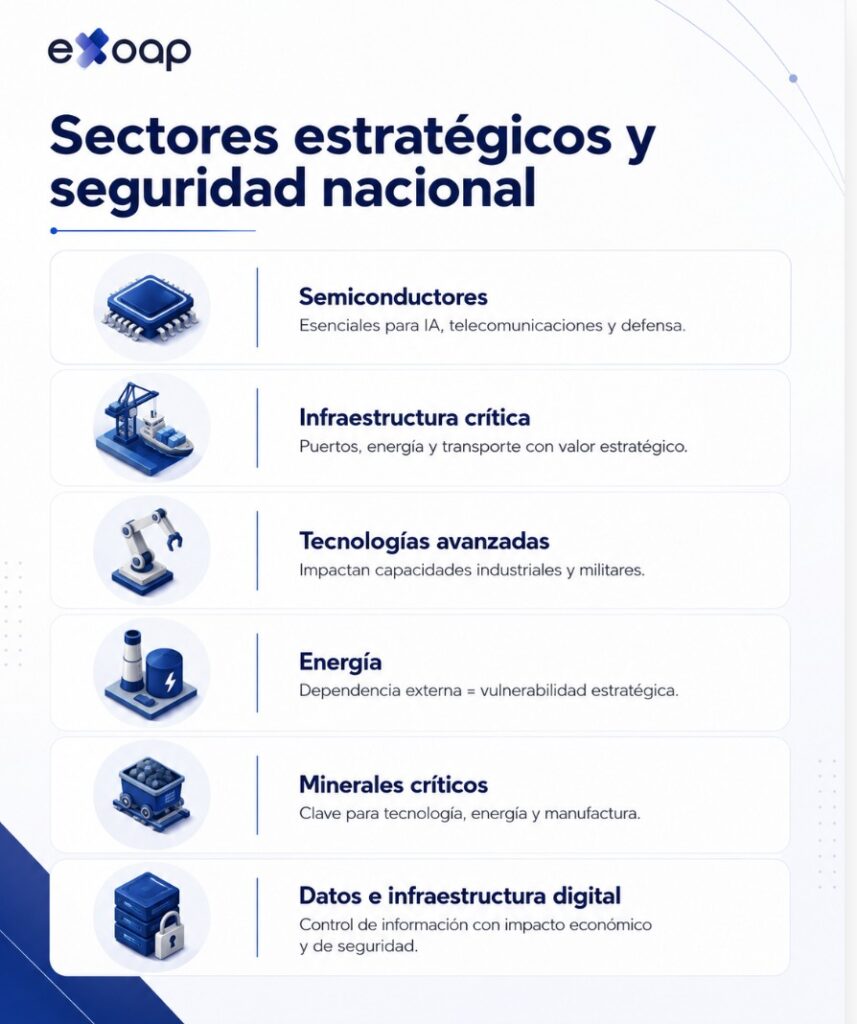
This is where one of the central challenges of contemporary economic policy emerges. Governments need foreign investment to strengthen productivity, infrastructure and industrial capacity, yet they are also seeking to avoid strategic dependencies.
Investment policy is therefore entering a phase of balancing two apparently contradictory objectives:
Economic openness + economic security
The OECD identifies precisely this tension: governments are seeking to attract productive capital while protecting strategic sectors from certain risks.
What does this mean for international companies?
For a company looking to expand abroad, the change has a direct consequence: entering a market is no longer simply a question of assessing profitability.
An international expansion strategy must also account for the regulatory environment governing foreign investment, sector-specific restrictions, screening mechanisms and the strategic sensitivity of the activity itself.
The OECD now maintains an index comparing regulatory restrictions on FDI across more than 100 economies and 22 sectors, precisely because market access conditions have become a material factor in international decision-making.
Conclusion
The securitisation of foreign investment does not mark the end of economic openness. It represents a change in how states assess the risks attached to certain forms of capital, technology and strategic assets.
In the new international environment, attracting investment means building a framework capable of distinguishing between productive investment, strategic investment and potential vulnerabilities.
For companies, understanding this logic will only become more important. Geopolitics is no longer external to investment decisions: it is becoming a central variable in determining where to invest, how to do so and which risks to manage.
References
Internal:
External: